
 Last Updated:
 This post may contain affiliate links which won’t change your price but will share some commission.
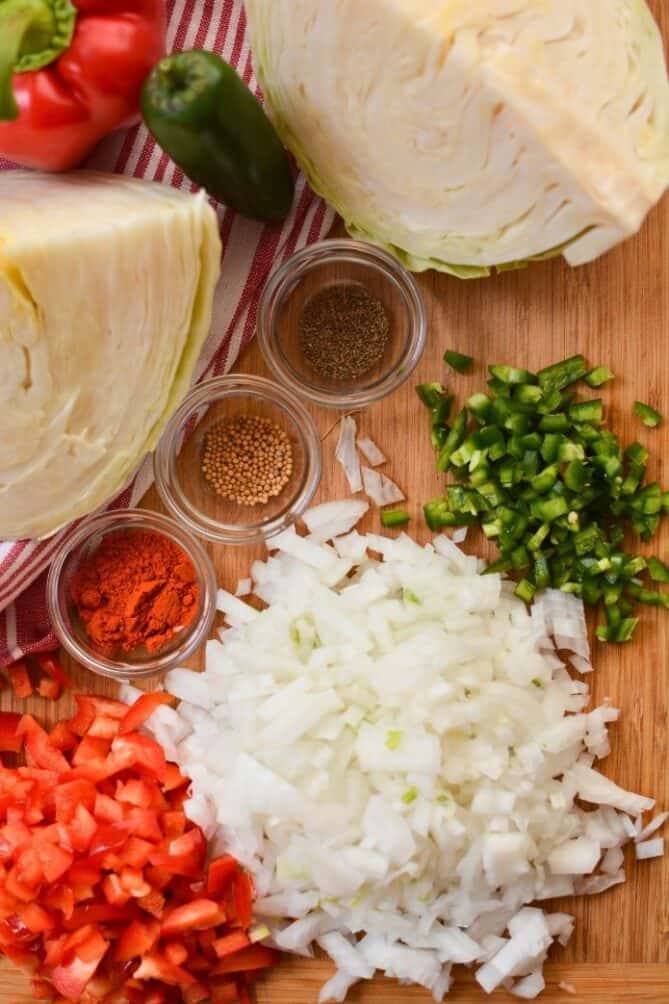
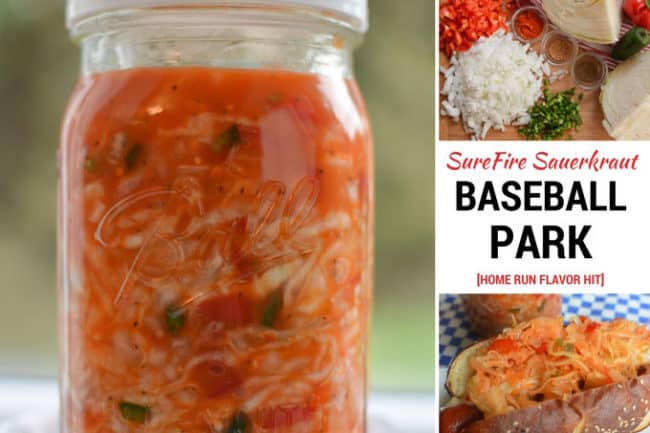
Baseball season or not, who doesn’t love a bit of extra zing in their meal? This Baseball Sauerkraut recipe brings the relish-like flavor you love to freshly grilled hot dogs, barbecued hamburgers, or just about anything that could use a flavorful boost.
Imagine enhancing your meals with a sauerkraut that not only aids digestion and boosts your immune system but also helps with protein digestion, making it a perfect companion for protein-rich dishes.
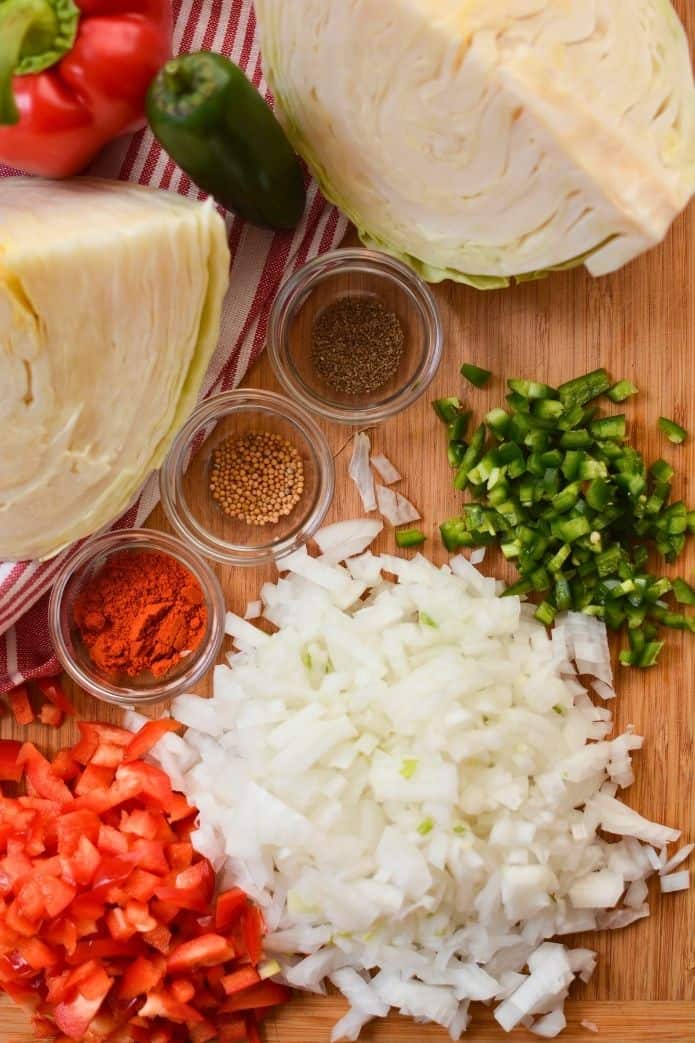
This Baseball Sauerkraut recipe, with its blend of sweet red peppers, spicy jalapeño, and mellowed onions, is reminiscent of enjoying a relish-topped hot dog at a baseball game. If the thought of onions has you hesitating, don’t worry—the fermentation process beautifully mellows the onion flavor, making it perfect for everyone.
If this is your first time making sauerkraut, learn how to choose the best cabbage for sauerkraut and use my teaching recipe: How to Make Sauerkraut In a Jar in 7 Simple Steps [Healthy, Flavorful, Easy], which is packed with step-by-step photos, tips, and additional fermentation info.
Once you’ve mastered that, return here to give your meals a home-run hit of flavor with Baseball Sauerkraut!
Baseball Sauerkraut is just one of many sauerkraut recipes found on my site. Passion Pink? Sweet Garlic?
In this post, you’ll also find practical tips on handling ingredients like jalapeño peppers and ways to enjoy your sauerkraut from sandwiches to salads.
Ready to play ball with your food?
Let’s get fermenting!
Notes and Tips to Get You Started on Baseball Sauerkraut
All About Onions
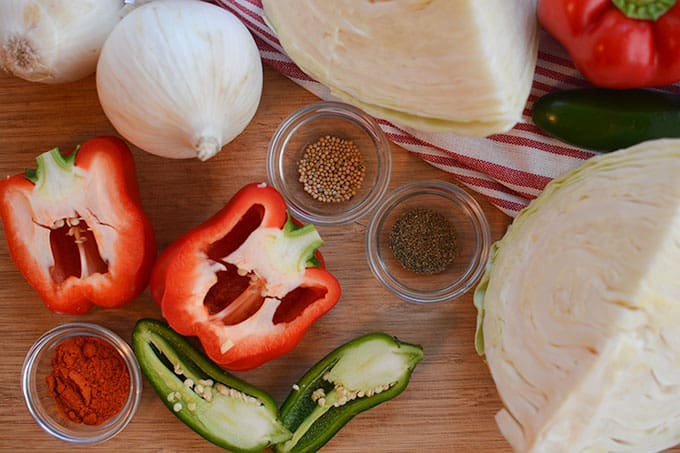
According to Kirsten and Christopher Shockey, authors of Fermented Vegetables, – my FAVORITE fermentation book, as reviewed here – onions are the only vegetable we know of that lack intrinsic lactic-acid bacteria, the bacteria we need to make fermentation happen. Adding cabbage to the sauerkraut recipe provides enough lactic acid bacteria to solve this problem.
I used white onions in this recipe, but it will work with any type of onion.
Yellow onions have a nice balance of astringency and sweet in their flavor and are most often used in cooked dishes.
White onions have a sharper and more pungent flavor than yellow onions. White onions tend to be more tender than yellow onions.
Red onions add a nice color to any dish and are often called for in salads, salsas, and other raw dishes due to their relatively mild flavor.
Prepping Jalapeno Peppers, How Much Heat Do You Want?
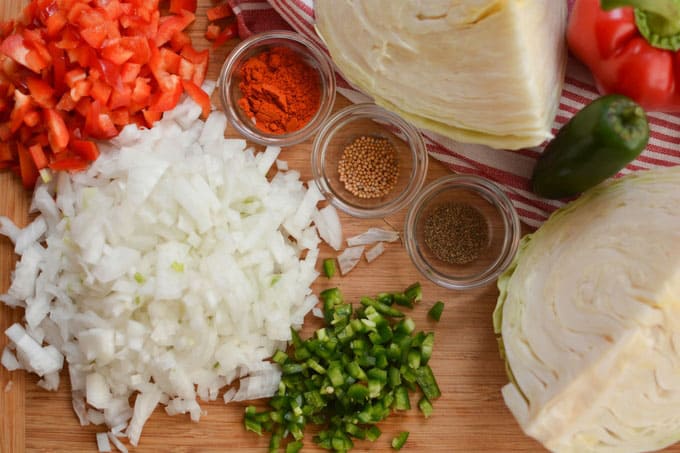
With hot peppers, the heat is in the seeds and the inner membrane. Vary the heat by how many seeds you leave in.
If you don’t like super-hot & spicy foods, cut off the stem and slice lengthwise. You might want to wear a glove for this, or be careful and wash your hands well after. With the tip of a knife or a small spoon, scrape the seeds out. To remove even more heat, also scrape out the inner pithy membrane.
If you like the heat, leave in the seeds and inner membrane.
Don’t Want to Irritate Your Hands with the Jalapeno Pepper?
If your hands are sensitive to the capsicum in the jalapeno pepper, don’t add the jalapeno pepper to your bowl until you have mixed all your cabbage and vegetables together and created your brine. Then, add the diced jalapeno, quickly mix and then pack into your jar. You might also want to consider wearing a pair of thin plastic gloves when making this sauerkraut or use a large spoon when mixing and packing.
Sweet Red Peppers
The sweet red pepper adds a nice burst of color to a ferment, a burst of color that fades over time, sadly. In addition, the high water content of peppers causes them to eventually lose their nice fresh crunch.
Onion to Cabbage Weight
For those of you who follow my general guidelines of keeping your “flavoring” ingredients to 25% of the total weight with sliced cabbage making up the remainder, rest assured. This recipe breaks that rule. It is more like an onion relish than sauerkraut. You will probably end up with a good pound of onions. Don’t worry. It will still ferment just fine.
5 Scrumptious Ways to Use Your Baseball Sauerkraut

1. Straight Out of the Jar
Don’t complicate matters and just add some to whatever meal you’re having. Simple!
2. Egg or Tuna Salad Sandwich
Finely chop a few spoonfuls of Baseball Sauerkraut and add to your favorite egg or tuna salad recipe. A nice shift from the typical, overly-sweet relish.
3. Potato or Macaroni Salad
Adding a few forkfuls of Baseball Sauerkraut to a potato or macaroni salad will add a punch of tangy flavor.
4. Deviled Eggs
Chop finely and add Baseball Sauerkraut to your next batch of deviled eggs. Sure to be a crowd pleaser.
5. Hot Dog? Hamburger?
The classic combination. Use as a topping for that grilled hot dog. After all, that’s what inspired this recipe. 😉
Also, see my ever-growing list of ways to enjoy your sauerkraut. Check out #13: To-Die-For Pizza Topping!
Are You Wanting to Ferment a Whole Crock of Baseball Sauerkraut?
Quantities for this sauerkraut recipe can easily be adjusted. It’s best to make – and pack your fermenting crock – with successive 5-pound batches (triple the ingredients of a 1-quart batch) until your crock is about 80% full. Follow How to Make Sauerkraut In a Crock in 7 Simple Steps [Healthy, Flavorful, Easy] for all the tips and tricks to ensure a home-run success.
The Five Tools I Grab Every Time I Make a Batch of Sauerkraut



Baseball Sauerkraut
EQUIPMENT
- Kitchen scale, ideally digital
- Cutting board and chef’s knife
- Large mixing bowl
- 1-quart (L) wide-mouth canning jar or similar sized jar
- 4-ounce (125 ml) canning jar (jelly jar) (or other "weight")
- Wide-mouth plastic storage cap. You can also use the lid and rim that comes with the jar.
INGREDIENTS
- 1 small head fresh green cabbage,, 1-1½ pounds
- 2 white onions,, baseball sized!
- 1 sweet red pepper
- 1 jalapeno pepper
- 1 tablespoon paprika powder
- 1/2 teaspoon mustard seeds
- 1/2 teaspoon celery seeds
- 1 tablespoon (15 ml) iodine-free salt (fine-grain), (2%)
INSTRUCTIONS
- SET UP. Gather Supplies and Set Up ScaleIn all my recipes, I have you use a kitchen scale to weigh your ingredients. Doing so really does make your life easier and your success almost guaranteed, because you add just the right amount of salt.You don’t want to include the weight of your bowl (the tare) in your measurements, so either zero out the scale (usually done with a button on a digital scale or a knob under the tray on a mechanical scale) or write down the tare (bowl) weight.

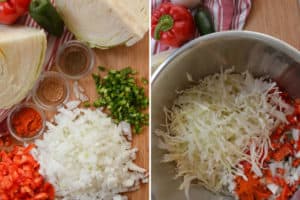
- CHOP. Prep Your Vegetables and CabbageYou'll now prepare all your flavoring ingredients and slice your cabbage into thin, ribbon-like strands. In this sauerkraut recipe, I have you dice your flavoring ingredients to try and duplicate the texture of a pickle relish. Finely dice your onions and add them to your bowl on the scale. With hot peppers, the heat is in the seeds and the inner membrane. Vary the heat by how many seeds you leave in.For both the sweet red pepper and jalapeno pepper cut off the stem and scrape out the inner membrane and seeds, but leaving in the seeds of the jalapeno pepper if you like a lot of heat in your ferments.Finely dice the peppers and add them to your bowl. Measure into your bowl: 1 tablespoon of paprika powder, 1/2 teaspoon of mustard seeds and 1/2 teaspoon of celery seeds. Discard the dirty or limp outer leaves of your cabbage, setting aside one of the cleaner leaves for use during the SUBMERGE step.Quarter, then slice cabbage crosswise into thin ribbons. I leave the core in, using it as part of my "handle" – but don't actually slice it – because I find it helps to hold the layers of cabbage together making the slicing job easier. See my post on ways to slice cabbage for some more tips. Add sliced cabbage to your bowl until the weight of your vegetables and cabbage is 1¾ pounds (28 ounces, 800 grams).
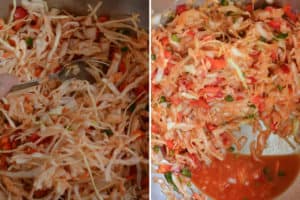
- SALT. Create Your BrineThis is where the magic happens. With the help of some salt, that big bowl of cabbage is condensed down and able to fit into your quart (liter) jar. Really!Sprinkle vegetables and cabbage with 1 tablespoon of salt (2% of total weight) and mix well.Then, massage the vegetables with strong hands until moist, creating the brine. If you're worried about getting the hot oils from the jalapeno on your hands, use a spoon to mix and press the mixture to get your brine. You should be able to tilt the bowl to the side and see a good-sized puddle of brine, about 2–3 inches in diameter. This process can take anywhere from 2 to 5 minutes. Notice how the mixture shrinks. If you're having trouble getting enough brine, read the tips in my post on dry sauerkraut.
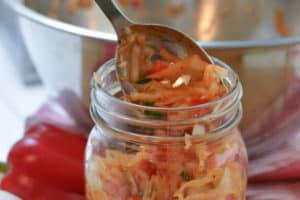
- PACK. Pack Mixture into JarOnce you notice a small puddle of brine in the bottom of your bowl (you may need to tilt it to one side to see it), it is time to pack the moist mixture into your jar. Grab handfuls of the salty, juicy cabbage mixture and pack them into your quart-sized (liter) wide-mouth canning jar, periodically pressing the mixture down tightly with your fist or a large spoon so that the brine rises above the top of the mixture and no air pockets remain.To keep the outside of your jar clean, hold the jar over the bowl with a clean hand – usually your left – and then use your other hand for packing the sauerkraut. Be sure to leave at least 1 inch of space between the top of the cabbage and the top of the jar. Because we weighed out just the right amount of cabbage to fit in your jar, this should happen automatically.Pour any brine left in your mixing bowl into the jar and scrape out any loose bits stuck to the sides of the bowl or to the sides of your jar.
- SUBMERGE. Hold Ferment Below BrineTo make sure your ferment is safe from the "bad guys," you'll use a weight of some sort to hold everything below the brine and a lid to keep out airborne molds and yeasts. Take that cabbage leaf you saved during the SETUP step, tear it down to just fit in the jar, and place it on the surface of the packed cabbage. Forgot to save a cabbage leaf? No problem. You can fold a narrow piece of parchment paper to size or even cut an old plastic lid to size. Place the 4-ounce jelly jar (or preferred weight) on top of the cabbage leaf, right side up with its lid removed.Lightly (to allow for escape of CO2 gases), screw on the white plastic storage lid (or airlock of your choice, following manufacturer's directions).I like to label my jars using green or blue painter’s tape and a permanent marker. I note the flavor of sauerkraut I made and the date I started fermenting.
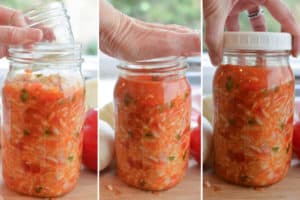
- FERMENT. Ferment for 1 to 4 WeeksTime now for the friendly bacteria to do their work while you watch and wait. Can you wait 7 days to taste the tangy crunch?Place your jar of fermenting sauerkraut in a shallow bowl (to catch the brine that may leak out during the first week of fermentation), out of direct sunlight. Wait for 1 week before opening to sample.For what to expect while your batch of sauerkraut is fermenting see: SALTY Cabbage to SOUR Sauerkraut: Fermentation Signs to MonitorYou can ferment your sauerkraut for up to 4 weeks. The longer you ferment it, the greater the number and variety of beneficial bacteria that can be produced, though most studies show numbers peaking at 21 days. Many like to check their ferment at the one-week mark and then determine ideal fermentation length for their household. More in the post mentioned above.
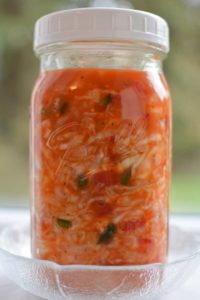
- STORE. Store in Refrigerator for Up to 1 YearAfter fermenting your sauerkraut, it can be put in your refrigerator and is ready to be eaten. Rinse off the outside of the jar. You can take the little jar out. Clean the rim if necessary (sometimes it can get sticky from the brine that overflows), and screw the lid back on tightly. Add to your label how long you fermented the contents.Enjoy a forkful or two of your sauerkraut with your meals. It will continue to ferment – aging like a fine wine – but at a much slower rate than before. If the flavors are too intense, leave the jar for a month or two and then eat it. You will be amazed at how the flavors have shifted. See 7 Easy Ways to Eat Sauerkraut for more ideas on how to enjoy your homemade jar of powerful probiotics. If successfully fermented, your sauerkraut can be kept preserved in your refrigerator for up to a year… at least!

Notes and Tips
- Yellow onions have a nice balance of astringency and sweet in their flavor and are most often used in cooked dishes.
- White onions have a sharper and more pungent flavor than yellow onions. White onions tend to be more tender than yellow onions.
- Red onions add a nice color to any dish and are often called for in salads, salsas, and other raw dishes due to their relatively mild flavor.
- If you don’t like super-hot & spicy foods, cut off the stem and slice lengthwise. You might want to wear a glove for this, or be careful and wash your hands well after. With the tip of a knife or a small spoon, scrape the seeds out. To remove even more heat, also scrape out the inner pithy membrane.
- If you like the heat, leave in the seeds and inner membrane.
- If your hands are sensitive to the capsicum in the jalapeno pepper, don’t add the jalapeno pepper to your bowl until you have mixed all your cabbage and vegetables together and created your brine. Then, add the diced jalapeno, quickly mix and then pack into your jar. You might also want to consider wearing a pair of thin plastic gloves when making this sauerkraut or use a large spoon when mixing and packing.
The Book That Will Transform Your Meals, And… Your Health
Learn to make gut-healing sauerkraut to instantly add delicious flavors to your meals. Step-by-step, easy-to-follow instruction with photos and tips.
Infographic: 7 Sauerkraut Recipes (In Short Form) to Tantalize Your Tastebuds
Check it out below!
Enter your email address below to be sent a quick guide PDF for seven delicious sauerkraut recipes. It will look similar to the infographic that follows but fit on one page that can be kept on your refrigerator for handy reference.
Sauerkraut Recipe Infographic
Ferment by pictures. Seven recipes to choose from.

Last update on 2026-09-16 / Affiliate links / Images from Amazon Product Advertising API

Your fresh new site is looking absolutely great Holly…crisp and clear with such wonderful mouth watering images to match your recipes…and I love your purple apron and blouse…3/4 sleeves an absolute must for making sauerkraut!
Thank YOU! The purple was planned, but not the 3/4 sleeve. Lucked out on that one. 🙂
Congrats on your new site; looks great! Can’t wait to try this new recipe.
Thank YOU! It’s delish, but treat it like a relish and don’t try to eat to the bottom of the jar in one sitting. 🙂 ENJOY!
Thank you Holly for sharing your expertise with us.
Lovely recipes, photos, etc.
Will be trying out new recipes x
That is excellent to hear. Make some sauerkraut to fill you home with mighty microbes, and thanks to wonderful readers like you, I’m always learning something new to share.
Thank you so much Holly for the great recipe to go along with the other, I have made your sweet garlic four times, each time it turns out perfect. I agree that weighing the ingredients makes a difference. Love the new website and the pictures are great. I look forward to making the baseball sauerkraut this weekend.
Excellent. I’m glad to hear how well the Sweet Garlic Sauerkraut recipe is working. Enjoy weighing out a batch of Baseball Sauerkraut this weekend. 🙂
I have made the sweet garlic sauerkraut and love it!! I often have it on poached eggs for breakfast. I can’t wait to try your new baseball sauerkraut recipe. Thank you so much for sharing your recipes with us all.
You’re quite welcome. Baseball Park Sauerkraut would also go quite well on poached eggs… with a bit of sour cream, too.
Hey holly do you know how to protect the teeth from acid? I’ve been eating the kraut for about 2 weeks and it has amazing health benefits (I managed to heal my chronic yeast infection!!!) but my teeth start to ache when I eat it 🙁 is there any way to prevent it?
Ania
Hello Anna, A great question. I’ll share a blog post from a favorite website of mine on tooth remineralization, because the tooth sensitivity you allude to is a “message from your guardian angel” that your teeth enamel is not as strong as it could be. At least, that’s how I treat such health “issues.” I use to experience the same with other acidic foods and really upped my foods rich in fat-soluble vitamins along with consuming lots of bone broth. This article is on teeth sensitivity from drinking Kombucha but it would be the same with acid in fermented vegetables. https://www.orawellness.com/how-to-drink-kombucha-and-not-destroy-your-teeth/ You don’t have to buy their products but it may get you exploring remineralization of teeth.
You are THE BEST. Thank you so much!!!
Thank you for being so open to other insights. I was afraid of stepping on toes. 🙂
Thanks for sharing this. I drink lots of Kombucha and eat quite a bit of kraut too, but I have never experienced sensitivity to these foods. However, about a year ago I did stop juicing after hav8ng done it daily for a few years, because every time I made a juice with lime or pineapple, and often I made them with both, I did have sensitivity. I will check it out. Thanks a bunch!
You’re welcome. I love the messages from my body. It gives focus to my current health hacking. I’ve always believed we can live a very long and healthy life and that diet is very important, along with good sleep and some exercise.
Same here. Listen to your body is one of the best pieces of advice we can give to people and then adjust your diet and exercise routine accordingly. 🙂
Hi Holly. Thank you for your wonderful and informative blogs and website. I frequently searched your site for information as I began my sauerkraut journey. I just put up a batch of this Baseball Sauerkraut. It sounds so yummy. I did have a conundrum as I was adding the cabbage to my bowl of vegetables. Before the cabbage I had 1 pound and 9 oz of veggies. Therefore I could only add 1/2 cup of cabbage before I reached your 1 and 3/4 pounds mark. My onions were over 1 pound themselves. How do your weight measurements of onions to cabbage compare to mine? I ended up adding another pound of cabbage and then enough salt, about 1 and 1/2 tablespoons to make the veggies salty enough by taste, per my past sauerkraut batches. I used a 1/2 gallon jar for the larger amount. I hope it turns out. Thanks again for the fun recipe. Teresa
I MUST give better sizing info in these recipes! 🙂 But, you handled it expertly. I would say the onions I used were each “baseball” sized. How convenient. You should be just fine. I probably had 1/2 flavoring ingredients and 1/2 cabbage in this recipe.
Hi Holly, I wanted to give you an update about how my additional cabbage and salt turned out. At one week in the jar, there is only one problem…….the taste test could have lead to me eating the whole jar right then. This stuff is SO GOOD!!!!! I am so excited about this new sauerkraut version. It is delicious!!! Thank you for sharing your wonderful recipe. I am looking forward to trying more of your kraut versions. Thank you for your blog!
Hello Teresa, You had me alarmed there for a moment with your ONE PROBLEM! 🙂 You don’t find it too strong? Anyway, very happy to have one more satisfied fermented of tantalizing sauerkraut.
Made my ballpark relish this morning. Looks great. Can’t wait to taste it ://uploads.disquscdn.com/images/488c1220e69a15b4a66d8a2758e27950f7229e47b7eb3692b636af466525e579.jpg
I love seeing pictures of my reader’s ferments. It has such a lovely color. Your brine should move up over the cabbage leaf by the end of the day.
https://uploads.disquscdn.com/images/4d3625e6082878c1433b85aa2f5de42aab45e39681f41e5b184cb2e6e41867a3.jpg Hi Holly. I just made a batch of the baseball park recipe and another with dill and juniper. One thing that surprised me a bit from this new recipe is that all the ingredients before adding the cabbage weighed more than half the total weight. But I’m guessing that as long as there,s enough brine in there, it’s all good. 😊 I can’t wait to try it out. Smells delicious. BTW, the paprika powder you used, was it hot or just smoked? Since I wasn’t sure, I used 50/50. It gave it a very Spanish chorizo-y smell.
As you can see in the pic, I have to cover some of the jars with a cloth and rubber after weighing them down, as I can’t seem to find any quart masons here. They’re not known in these parts other than by us folks who follow North American cooks and the like. Amazon sells them but they are so much more expensive than the US Amazon and I can’t buy them there because they don’t ship them to Spain.
Anyhow, I’m still looking for masons and/or some fermentation jar/lid/seal system. Gotta read through your reviews 😆
Will let you know how I like this recipe, although I can already tell you it looks and smells like it’s going to hit it out of the park!
Looking lovely! Yup, you caught me on that one.. way past the 25% mark on “flavoring” ingredients. That’s more of an issue with sweet ingredients and when trying to keep the sauerkraut flavor. This recipe leans more towards a relish.
Those living in the US, don’t realize how simple buying “stuff” is. I live in Canada and even here, it’s a challenge for some items. My son’s batteries for his RC planes are double the price. Oh, well. Not complaining, just understanding your dilemma.
I used just regular paprika, not hot, not smokey, but of course each of those would work great. Enjoy the new flavors.
Thanks, Holly. I’ll let you know how they turn out. Cheers 😉 BTW, I also didn’t have any celery seeds so I used Fenugreek instead. Never used it before but I had it lying around so I gave it a go.
Hi again, Holly. I just wanted to let you know that this is my new favourite recipe!!!!! Even though in my case, due to the size of the onions, it had just under 50% cabbage, this kraut is the bomb!!!! The flavours are mindblowing. They explode in your mouth and there’s so many different layers to them. I particularly like having used the smoked paprika because I think it goes really really well with the rest of the ingredients. This is great for sausages and meats in general (although it does have a somewhat overpowering flavour), but I am eating it with all sorts of other foods too. I particularly like it on bread with avocado. I still have some left from the previous batch but I am going to make it again this weekend. I don’t want to run out, hahaha… 🙂 This time round I will try with a bit less onion, see how it turns out.
Cheers, as always, for everything that you share with us. Much appreciated and very grateful.
Hello Marco, I always enjoy your updates. Thank YOU!
How many favorites can one have? I like the idea of smoked paprika. I want to try a batch using the s-blade on my food processor to chop everything to make it closer to a relish texture. All the best. 🙂
Funny you should say that about the S blade, because I accidentally left it in as well as the slicer blade and half of the batch turned out like that 🙂 Will try to do all of it too for this next batch, as I couldn’t make it last weekend in the end.
I just made a double batch of this recipe again, following your recommendation I made it with the S blade, first very finely grating the cabbage and then kind of mashing the onions with the pepper and all the spices into a purée. The texture is lovely but I wouldn’t advise this method unless you have a special fermenting vessel with a pushing mechanism, as it becomes very difficult to keep everything below the brine this way due to all the tyni bits. But I did manage to make it. Let’s see if it all stays below. Will keep you posted.
Thanks for experimenting and sharing your results, though a bit frustrating, I’m sure.
This site is just so amazing! Thank you for your efforts! I’m going to make my first batch of simple kraut this afternoon. I’m looking forward to trying all of your different recipes.
YOU’RE WELCOME! You have the perfect avatar for this post. Are you daring enough to share some Baseball Sauerkraut Relish with the team? Hope your first batch of sauerkraut is fermenting.
I saw this recipe a few weeks ago and have been waiting to make it. Bought a huge head (12 lbs) of cabbage and realized I had no clue what all to make. First, I did sauerkraut (haven’t done it in years and due to some difficulties gave up trying.) Now, with the Internet, videos, photos, and the ability to ask questions, I tried and loved our first batch. This one is now quietly sitting on my counter I did have about 3 tablespoons extra so I put that in a container in the frig. I tried a little just because I could and it is amazing fresh! I also re-read the directions and saw the 1 inch headspace instruction- so glad I caught that before things got going! Thank you for sharing.
You’re welcome. Enjoy this one, and… its “amazingly fresh” flavors. 🙂
Thank you Holly! Made kraut for the first time about a year ago thanks to reading this website. The Baseball recipe…friends and family are now fighting for it after every jar is finally done. Can’t keep it very long. It is without a doubt a game changer for hot dog lovers.
I now have tried about 15 of my own recipes and wanted to share the favorites aside from the Baseball Kraut.
RAMPS – Living in the heart of the Allegheny Mountains, wild ramp onions are now abundant in the spring and I have been preserving them for years in many ways to make them last through the off-season. Well, ramps and sauerkraut are amazing. I didn’t want to add any seasonings to make sure I got as true of a ramp flavor as possible so just stuck with the basics of cabbage and salt and ramps and WOW!
OLD BAY AND CORN – Fresh summer corn is awesome in sauerkraut. In Maryland we love Old Bay seafood seasoning. Really, really good recipe. Just corn, old bay, salt and cabbage. But lessen the salt as Old Bay has some in it as well
PEPPERONCINI – I grow pepperoncinis in the garden. If you love them pickled and in a jar on the market shelf, throw some in with the cabbage and salt. Or use the ones already on the market shelf.
Again, thanks to Holly for getting me started (and now addicted). She made it very easy. Peace!
I always love to hear when someone becomes “addicted” to these delicious ferments. 🙂 You’re most welcome!
Thank you for sharing your recipes. I wish we had wild ramps growing here. Your recipe skills will keep your friends around.
Can I water bath pints of baseball sauerkraut, the same way I do regular kraut?
I am not experienced with canning sauerkraut. But I know that other readers have canned it. I would search for a recipe for canning naturally fermented sauerkraut.