
 Last Updated:
 This post may contain affiliate links which won’t change your price but will share some commission.
Have you ever had batches of sauerkraut that turned out mushy or slimy? Or perhaps you’ve found mold and had to toss your hard work? These issues often boil down to one key factor: how much salt you use.
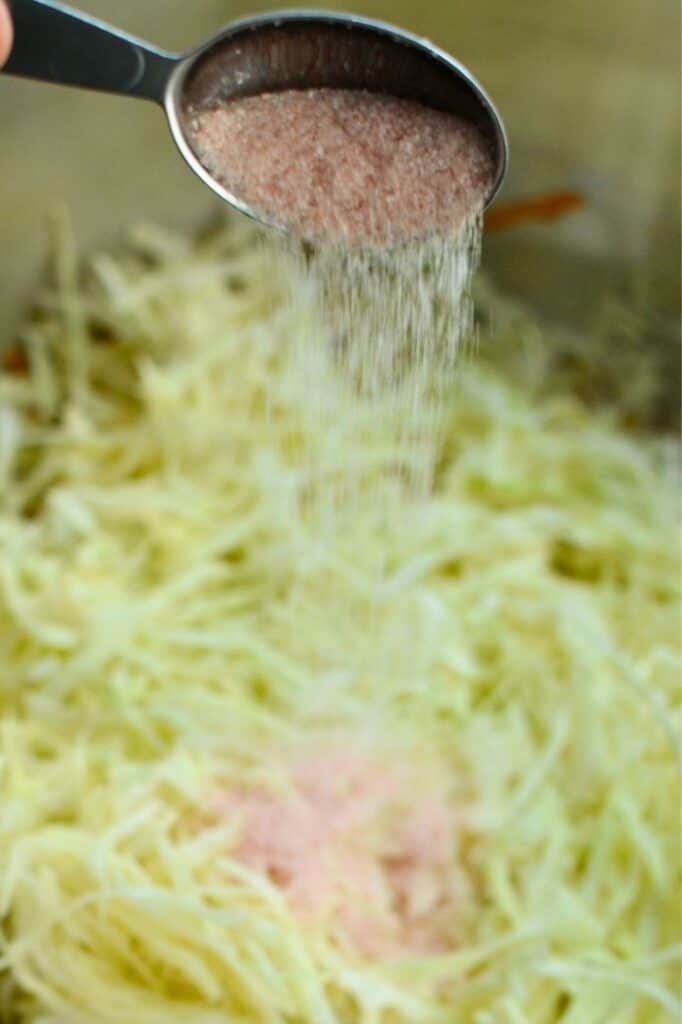
Making sauerkraut can sometimes be tricky, especially when it comes to getting the right amount of salt.
Too much or too little can lead to problems like mushiness, sliminess, or even mold.
In this post, we’ll dive into why salinity is so crucial and how it affects your sauerkraut.
We’ll discuss the importance of salt in creating brine, reducing mold, ensuring a crisp texture, and controlling fermentation.
You’ll also learn about the ideal 2% brine ratio and how to measure salt by taste, volume, or weight.
To make things easier, we’ve included a handy table and a FREE PDF download.
FREE PDF Download
Use the button below to grab my handy Best Salt & How Much Salt PDF.
Why Do You Need Salt Anyway?
Salt pulls water out of the cabbage and vegetables to create a brine that the cabbage mixture is packed in. A fermentation weight of some sort is placed on top of this packed mixture to keep your ferment safe from airborne yeasts and molds.
We need that brine. It is under that brine that our ferment stays safe.
This briny environment is where the good bacteria (mainly lactobacillus) can grow and proliferate and the bad bacteria die off.
The success of your lacto-fermented sauerkraut depends on using the proper amount of salt for the quantity of vegetables you’re fermenting. This applies not just to the cabbage but to the other vegetables and seasonings, you add, too.
The amount of salt used affects the rate at which fermentation proceeds, the quality of the fermentation environment, and the types of microorganisms that will grow and thrive there.
Learning to calculate and add the correct amount of salt is important for many reasons.
Create enough brine
Salt helps pull water out of the cabbage and vegetables to create an environment—a salty brine—for happy fermentation.
Reduce chances of mold
Too little salt is a “Come and live here.” invitation to the “nasties” (mold or slime) that you don’t want in your jar.
Create a nice, crisp texture
Too little salt inhibits or prevents fermentation and tends to create softer sauerkraut. And… if you prefer sauerkraut with less crunch, you can use a tad less salt.
Control the rate of fermentation
The amount of salt you use determines the rate at which fermentation takes place.
Too much salt is a “Go away.” sign for the beneficial bacteria, the lactobacillus that you want living and multiplying in your jar. Fermentation slows way down or doesn’t happen at all.
Not enough salt and fermentation proceeds too rapidly, and the sauerkraut turns out soft and mold is more likely to grow.
The Sweet Spot: A 2% Brine
The best fermentation results are achieved with a 2% brine. This is your “sauerkraut salt percentage” or, more accurately “salt concentration.”
The easiest way to think about this is in grams.
For every 100 grams of cabbage, you need 2 grams of salt (100 grams x .02 = 2 grams).
You won’t have to do these calculations; my recipes are already set up to achieve this 2% brine ratio. I’m just trying to give you an understanding of where the salt measurements come from and why the amount is important.
A 2% brine ratio ensures a happy fermentation environment and results in crispy, tangy sauerkraut. You will need a scale to weigh your vegetables, as I discuss here.
How much salt per pound of cabbage?
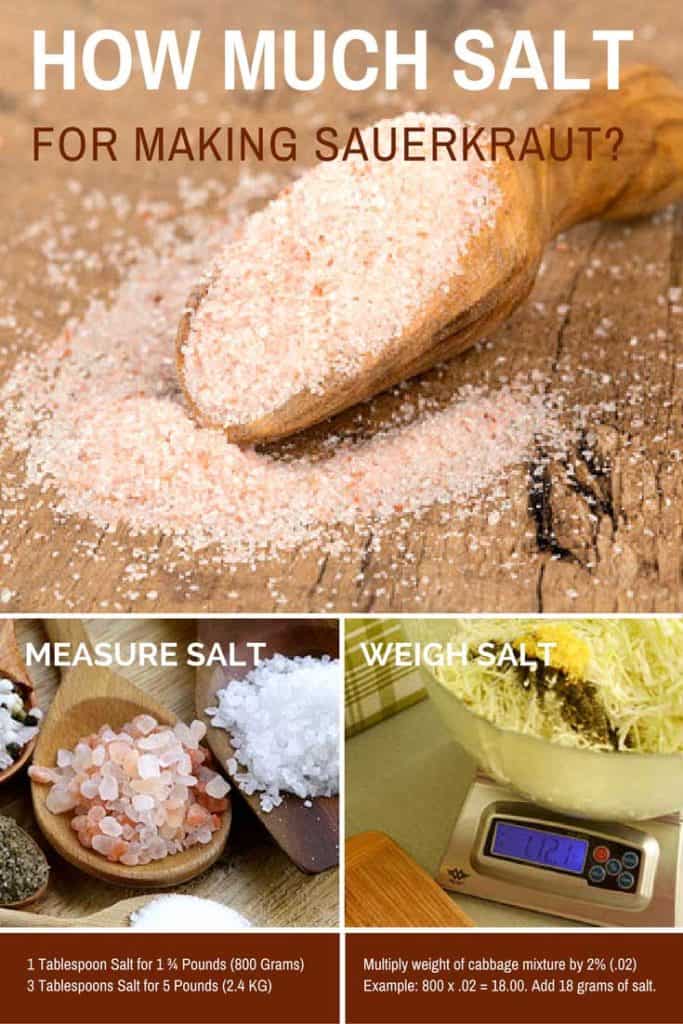
1 tablespoon (16 grams) of salt for 1¾ pound of cabbage & other ingredients.
Or, if you are working in grams—MUCH easier:
1 tablespoon (16 grams) of salt for 800 grams of cabbage & other ingredients.
To make a quantity of sauerkraut that will fit in a 1-quart (liter) jar, you will need 1 tablespoon of salt for every 1¾ pounds (800 grams) of vegetables. These are the quantities I use because this amount fits perfectly into a 1-quart jar—the right size for the beginning fermenter.
Although you can use just about any salt—as long as it does not contain iodide or other additives—my favorite is Himalayan Pink Salt. My post on the best salt for sauerkraut covers all your options.
3 Ways to Determine How Much Salt to Add to a Ferment
There are three ways to determine the proper amount of salt: Taste, Volume, and Weight. Volume is the method I use and teach on this website.
Taste

To add salt by taste to your ferment, you slice your cabbage and vegetables, sprinkle on some salt, mix well, and taste.
If it tastes salty like a potato chip, you have the right amount.
If it tastes overly salty, like seawater, you’ve added too much salt and need to adjust the quantity of your ingredients. Add some more sliced cabbage, mix, and taste again.
You can make sauerkraut this way, and I did so for years. But, some of your batches may turn out too salty, some too soft, and some may mold.
All of our tastebuds and what tastes salty to one person may not to the next. In addition, people with adrenal fatigue may crave salt or salty foods and not be able to accurately rate how salty something tastes.
Volume
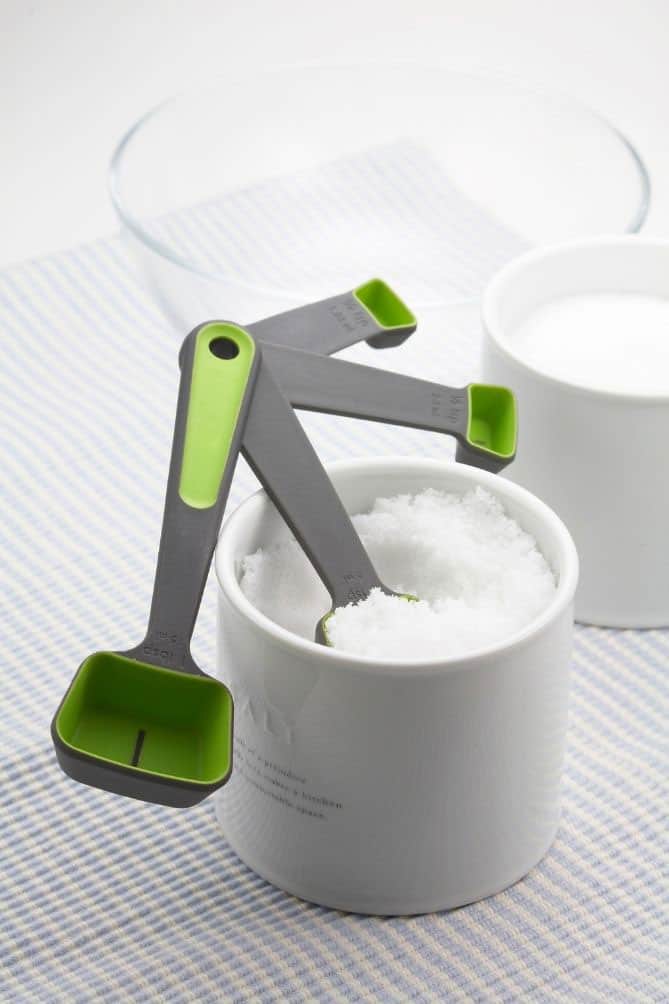
To add salt by volume, you weigh your cabbage and ingredients and then add a set amount of salt using a measuring spoon. The size of your measuring spoon is the volume of salt you are adding.
Microbiologists have determined the correct amount of salt to add with the range being 1.5% to 2.5%.
For a one-quart (liter) batch of sauerkraut, you weigh 1 ¾ pound (800 g) of vegetables and add 1 tablespoon of salt.
One drawback to calculating salt by volume is that not all tablespoons are the same size. In Australia, a tablespoon is 20 ml; in Great Britain, 17.7 ml (at least historically): in North America and elsewhere, 14.7 ml. That’s a 25% difference in tablespoons between the U.S. and Australia.
You’ll want to know the volume of your tablespoon when measuring salt by volume. I have two sets and have always thought one looked a bit larger than the other. It is!
Another drawback to calculating salt by volume is that different salts weigh different amounts. This is due to variances in grind size, density, and moisture content. You’ll fit less of a large grain of salt into your tablespoon than you will a fine grain.
Weight
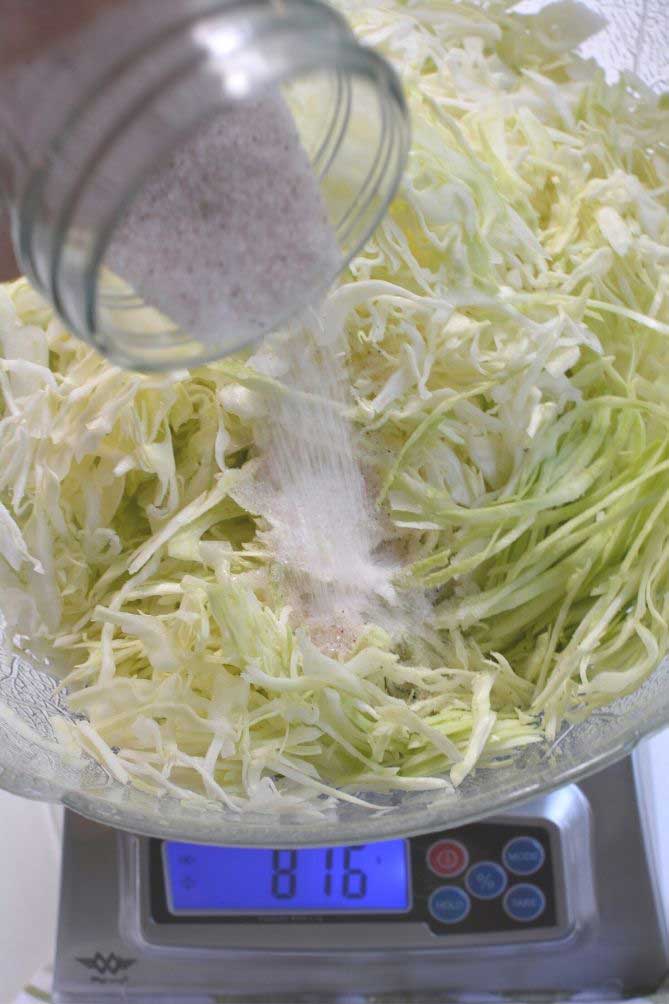
To calculate how much salt to add using weight, you weigh BOTH your ingredients AND your salt.
First, weigh your vegetables in grams and then multiply their weight by 0.02 (that is, 2%) to get the required amount of salt in grams.
For example, 800 grams of vegetables would require 16 grams of salt or 800 x 0.02.
Learning to calculate salt by weight can be a game changer. It takes the guesswork out of fermentation and enables you to easily adjust batches for fermentation temperature or sweet ingredients.
If you’re fermenting in cooler weather, you can use a tad less salt: 1.5%.
If you’re fermenting in warmer weather, you can use a tad more salt to slow the fermentation down a bit: 2.5%.
Sweet vegetables or fruits (beets, carrots, apples, dried fruit) in a ferment give the bacteria more sugar to eat and can speed up fermentation or give the alcohol-producing bacteria an edge. To slow things down a bit use a tad more salt: 2.5%.
TABLE: How to add salt by taste, volume, or weight
| Taste | Sprinkle 1–-2 pounds of cabbage/vegetable mixture with 1 Tbsp salt and taste. It should taste salty, but not offensively so. Add more salt or more vegetables, if necessary. |
| Volume | 1 Tbsp salt for 1 ¾ pound (800 g) of cabbage/vegetable mixture to make 1 quart of sauerkraut. 3 Tbsp salt for 5 pounds (2400 g) of cabbage/vegetable mixture to make 3 quarts of sauerkraut. |
| Weight | 2% salt by weight (Use a digital scale set to grams.) 16 grams of salt for 800 grams of cabbage/vegetable mixture to make 1 quart of sauerkraut. |
| Extra Brine | 1 Tbsp salt in 2 cups water. Use this mixture if you need to add more brine during the first 10 days of the fermentation process. |
Frequently Asked Questions about How Much Salt for Fermentation
Yes, you can rinse your sauerkraut if you find it to be too salty. This will remove some, but not all, of the beneficial probiotics.
You can also disperse the salty flavor by mixing it into a salad or even mixing it with another batch of sauerkraut.
Sauerkraut will taste salty due to it being fermented in salt. However, it should not taste overly salty. There are a couple of reasons for a finished batch of sauerkraut to taste too salty.
One, Too much salt was added.
Two, Not enough lactic acid was produced during the fermentation process. During fermentation, the bacteria eat the sugars in the cabbage and produce lactic acid to give sauerkraut its tang and mask the salty taste. Not fermenting long enough or not using cabbage with enough sweetness could be the cause.
If you’re fermenting in cooler weather, you can use a tad less salt: 1.5%.
If you’re fermenting in warmer weather, you can use a tad more salt to slow the fermentation down a bit: 2.5%.
2.0% by weight for the amount of cabbage/vegetables you’re fermenting. Or,
1 Tbsp salt for 1 ¾ pound (800 g) of cabbage/vegetables to make 1 quart of sauerkraut.
3 Tbsp salt for 5 pounds (2400 g) of cabbage/vegetables to make 3 quarts of sauerkraut.
Grab a scale—or learn more about my favorite scale, weigh out your cabbage, sprinkle it with just the right amount of salt, and let me know the results. Tangy with just the right crunch?
Want help selecting a scale to buy? See:
Fermenting Supplies for Sauerkraut & Vegetables [The Classics, The Latest, The Greatest]
Want help choosing what salt to use? See:
What is the Best Salt to Use When Making Fermented Sauerkraut?
Or, want to just follow a recipe with it all figured out for you?
How to Make Sauerkraut in a Jar in 7 Simple Steps [Healthy, Flavorful, Easy]
I’ve got you covered. Just follow my recipe. It uses not too much salt… not too little salt… but, just the right amount!
FREE PDF Download
Use the button below to grab my handy Best Salt & How Much Salt PDF.
Last update on 2026-10-19 / Affiliate links / Images from Amazon Product Advertising API


Erroneous logic.
You mustn’t determine the salt by the weight/mass or vegetables, but as a water solution. The optimal salt content of the brine is between 3.5 and 5%. In other words, you have to add 3.5 to 5 grams salt to 1 litre water. A tablespoon contains about 7 grams of salt.
Hello Kara_kan, Thanks for sharing your insights and chemistry know-how. You’ve got me thinking. My brain will have to ponder this awhile to determine how best to properly describe the correct amount of salt to use.
The way I understand it is, for sauerkraut, we’re “dry-salting” and we know how much salt works for a particular weight of cabbage/vegetable mixture. That salt extracts liquid from the cabbage and then we have our brine, which research indicates that this results in a 2% brine. For pickles, a 3.5% brine is first mixed and then poured over the cucumbers… The discussion continues.
Dear Holly,
The method you use is overcomplicated.
You can never determine the exact water content of vegetables without burning or at least completely drying them. It is much more easier to keep under control the salt content of water you add. Of course, you cannot know the exact volume of water you will use, but throwing away a few cups of remaining water or using it for other purposes is not an issue.
My method is very simple: I fill the crock, jar etc. used for making sauerkraut with the vegetables, then I pour the brine (prepared in advance, i.e. ab. 3% solution of salt in water) over till the crock etc. is full (a few inches above the pressed down vegetables. Any water evaporating later is replaced with the same salty solution. (So, the salt concentration will increase over time, but this is OK ← let me avoid the explanation for this now.)
The key of success is to keep the vegetables under the salty solution all the time.
The fermentation period I use is 4 weeks.
The temperature is 20°C. (68°F) (room temp.)
After a month everything goes in the fridge in jars of ab. 1 pond. I add 1 tablespoon of (apple or wine) vinegar and one quarter of teaspoon Vitamin C to each jar.
My next plan is to add some whey during fermentation. I have never tried that, so I am curious how will that end up.
Hello Kara_kan, Yes, you’re method is very simple and is what I would use IF I were fermenting vegetables (e.g., carrots, garlic, cucumbers).
I’m making sauerkraut where I don’t make a brine but instead add salt for the cabbage and bacteria to make their own brine. We’re talking two different processes.
I see that you add vinegar and Vit C to your finished brined vegetables. What do you find that helps with? Keeping them fresh, longer?
Hello Holly Howe!
Yes, that’s the reason why I add Vit C and some apple or wine vinegar: for extending preservation time.
One more thing to add to my “Experiment List,” because I do make all my sauerkraut in the Fall and eat it over the upcoming year.
Your method sounds like a Kimchi recipe where the vegetables are often soaked in brine then removed and packed in the crock. Since sauerkraut is cut finer it will lose more internal juices to the brine (which is not generally in the final product). This will make for a weaker flavor.
For your next plan, adding any starter bacteria will get the sauerkraut to ferment almost exclusively with the lactobacillus. When you naturally ferment there is a progression of bacteria, each of which adds a different flavor and changes the PH until only lactobacillus remains. This can lead to funk if it takes too long for the lactobacillus to dominate, but usually leads to more complex flavors that really distinguish homemade sauerkraut from the commercial alternatives.
Hello!
Thanks for the reply!
Actually I do not remove and repack anything anywhere. Salt from the brine is absorbed by vegetables and takes part in chemical reaction, so the final product isn’t too salty, just good for consumption. Your idea about adding – or more precisely NOT adding – any Lactobacillus culture at fermentation start is worth considering.
If you do add a starter, I would recommend waiting at least 3 days for the ferment to develop some character.
Hi Holly,
I’ve made sauerkraut with measuring sat by weight. Had good success with 2%, 1%, 0.5%, 0.35%. My l last batch I used 0.25% of salt to cabbage ratio, and my kraut came out mushy, perhaps I went too low.
Thanks so much for sharing this. It will be helpful for those trying to reduce salt. I get this question often. How long are you fermenting?
I haven’t had the time to experiment, yet and still lean towards creating the ideal environment for the bacteria to do their work.
Fortunately you don’t have to be that accurate for sauerkraut. Just measure out 2 pounds of cabbage and use 1 table spoon full of canning salt. Works every time. Lets keep it simple so there are no mistakes.
Hi Holly. I have been using your method and it works perfectly. I rather have the salt draw out the moisture with a bit of hand massaging of the shredded cabbage, than to add salted water. Who knows what is in the added water, even filtered. I only ferment for 9 days and it turns out perfectly! I have a question though. I normally boil the glass containers for approx 5 min before use. Is that a necessary step or can I just wash the containers with hot soapy water and air dry prior to use? Thanks again for your guidance!
Hello Dina, Save yourself a step and just wash well. Glad to hear you’re making yummy 9-day sauerkraut. Thanks for letting me know that all is working well. Much appreciated.
You could also just soak in something like Milton steriliser then just drain.
I would advise against a sterilizing agent. What residue it might leave behind could interfere with fermentation.
Hi Holly,
I am making sauerkraut for the first time. I am curious how long the salting process takes to get the water out of the cabbage. I started mine 2 hours ago and I am concerned that I may need to just add brine to my cabbage to get the liquid content up. I did weight it after I’d salted it and I have 3 lb of cabbage and I have added 2 Tbsp of salt.
Did you give it a good massage? Squeeze and press? Usually, with an hour of sitting and a few minutes of massages, you’ll have plenty of brine. See this post for a few more ideas: https://www.makesauerkraut.com/dry-sauerkraut-gut-shots-recipe/
No I didn’t massage. Thank you. I will add brine for this batch. Perhaps massage next batch. Thanks Holly!
The very easiest way for me to arrive at (OR VERY NEAR) the 2% brine level is : For every pound of cabbage add 10 grams of salt. 2.3 pounds of cabbage, no problem, 23 grams of salt. My scale has several modes, so it has never been a problem to switch between pounds and grams. 10 to 1, (grams of salt per pound) is just an easy way for me to figure the amount of salt. It might be confusing for others that do not have a scale which can display grams or a scale that only displays pounds and ounces, UNLESS, you are good with calculations. 🤔???
Sounds like a very workable solution for those working in pounds.
Thank you! Your ratio of 1 tbsp (in my case Terrasoul Himalayan pink) salt to 1.75 lbs of cabbage did the trick! I went just a tad over the 1 tbsp to bring it to 16 g (estimated, I have a basic spring scale). I shredded the cabbage, sprinkled, mixed and jarred. Had great fermentation quickly! I used your 2% ratio to keep a brine over the cabbage. I am a beer maker so I used air locks in a pre-drilled re-purposed pickle jar. After 3-4 days it was really good! After 7 days, the fermentation slowed (no more bubbling). I then put it in plastic tubs and refrigerated. No mold or anything funky during ferment. It was SO much better than I imagined it would be. I know it kills the probiotic effect, but I did take some of the kraut and sauteed it with onions and served with sausages – EXCELLENT! I am going right now to get some more fresh cabbage. This will remain a staple for me! Thanks again!
You’re Welcome! Happy to hear you are enjoying another fermentation adventure. Your beer making skills have transferred rather nicely. And, don’t worry about sauteing the sauerkraut. It does add great flavor to a dish. Just have some raw alongside. Best of both worlds.
I just made Sauerkraut in a 2 gallon crock this morning using my family’s tried and true method and now after reading this I’m wondering if I messed up. I put 2 tablespoons of kosher salt on about 4 heads of cabbage and worked it in. I let it sit for about 15 minutes then added 2 quarts of water mixed with 6 tablespoons of kosher salt. I weighed it down so the vegetables were completely covered in brine. Am I clear in reading that you don’t add water at all?
Hello Pamela, This is more than one way to make sauerkraut, though I may not like to admit that. 🙂 See how you batch turns out and go from there.
I don’t know what your cabbage head size was, but 2T of salt works wells for 5-6 pounds of cabbage. No, I don’t add water/brine but instead create that brine by the salt pulling moisture out of the cabbage.
My batch was incredible! I just made another and this time I didn’t add water I’m using your method to see which method I like better. Thanks for posting.
That is great to hear! Now, I’ll wait to hear how your current batch compares. Keep on Fermenting!
I am making sauerkraut monthly. Love mixing 1 red and two white cabbages. Yes going through 3 medium cabbages a month. Nice colours in Kilner Fermentation set. I am getting perfect results weighing salt using your cabbage weight x0.02 calculation to get 2% salinity.
Has anybody noticed an increase in their blood pressure or is it a coincidence?
Next batch I will try wtx0.015 & try a 1.5% salinity.
Hello Paul, Great to hear of all that sauerkraut you’re making… and consuming! No problem dropping down to the 1.5% salinity. In fact, due to my inaccurate tablespoon that’s what I’ve been using. It helps to use the mineral-rich salts if you’re concerned about blood pressure. Do some searching for “alternative” viewpoints on blood pressure and salt. I’ll eventually do a post. And, sauerkraut is usually consumed as a “condiment;” 1/4 to 1/2 cup daily (less salt….).
Hi, my name is Chris. I have been fermenting for about a year now. I have become pretty good at garlic dill pickles and Korean kimchi. I have just made my 2nd batch of sauerkraut. Thank you for the easiest understanding of salt to cabbage recipe. My 1st batch came out well but I underestimated how much the cabbage would break down and my crock was only a little over half full. I just finished loading my 2nd batch. My question is, would it be a good idea to put a cupfull or so of the brine in my pickles in my crock with sauerkraut to help kickstart the probiotic cultures in the fermenting cabbage. I do this every time I make more pickles but would like to know if this could apply to sauerkraut. Thank you for the very helpful site. Chris. ( my wife is Michelle if the e-mail is confusing).
Hello Chris, I know many people do just that, but I recommend against it. You are introducing different bacteria than are needed at the onset of fermentation. What is on your cucumbers – or cabbage – is all that is need to start fermentation. Those starter bacteria are different bacteria than the finishing bacteria. More here: http://www.makesauerkraut.com/starter-cultures-not-used/ I’m glad you’re enjoying the site. Keep on making all those delicious ferments.
I made 10 liters of sourkraut yesterday. I made it with regular salt which contains iodine. Will my kraut be ok?
Most likely YES! There’s an ideal but the bacteria tend to adapt. The issue is that iodine tends to kill the bacteria we need for fermentation.
Thank you! It turned out great! Will remember no iodine next time!
Yaaa!!! Thank goodness for the flexibility of fermentation and thank you for letting us know it turned out so well. Enjoy!.
Made a plain, no air lock, crock full, 10 days ago. Used a large red cabbage, about 2 tablespoons of plain non iodised sea salt (weighed it to get amount), and some caraway seeds, kneaded it to release the juices, packed tightly in crock, covered with large cabbage leaf and weighed down with 3 saucers, covered crock with lid and cloth tied on the top. Ambient daytime temperature around 28 degrees Celsius and a couple of degrees less at night. Inspected every few days and nothing seems to be happening. No visible bubbles or froth but had a very small amount of scum on the edge of the saucers, has pleasant wet cabbage smells in the crock. Took a sample today, lovely translucent pink/red colour, crisp to eat, tastes O.K. but can’t be sure if it is a salt or sour taste. Was expecting something more sour. (Never eaten S/Kraut before so have nothing to compare the taste with).
Is it normal to have no visible signs of fermentation?
Are normal things happening here?
If I leave it for a few more weeks will it get more sour or will it spoil?
Hello, It sounds like you are on the right track. Red cabbage is a bit tougher and does take longer to ferment. At 28 degrees there should be more activity, though. If you press down on the plate, do you see bubbles? Were there bubbles during the first 5 days? Give it a bit more time. Perhaps you can buy a jar of sauerkraut for comparison. You’re looking for a sour taste, not a salty cabbage taste. See this post for what else to watch for: https://www.makesauerkraut.com/fermentation-signs/
Wonderful website! I was googling an amount of salt to be used in sauerkraut and I came across your website. I am going to spent countless hours here (LOL) and read every single post. Thank you so much! It is the best site on fermentation and I have seen many. You have lots of original information too that I have not seen anywhere else.
Quick question please: I love lacto fermented stuff. I could eat pickles, sauerkraut etc. by the pound. Having said that, is there such thing as eating too much lactoferments? I read recommendations on the internet that you should have a Tbsp or so of ferments with every meal. For me Tbsp is nothing. Why even bother (LOL). I grew up on lactoferments. When I was a kid my mom used to make them for every winter. I am originally from Poland and now I live in Canada.
So as I said I could easily have a big plate of lactoferments. Is it OK? Any downsides? Too much of a good thing? I do not have any issues afterwards.
Thank you in advance.
Alana
Technically, fermented foods are eaten more as a condiment than the star attraction as a meal. I would cut back if you’re noticing any digestive issues. There is this one post to ponder (under Last Words): http://darwinian-medicine.com/ask-eirik-how-many-bacteria-are-there-in-sauerkraut/
I try to steer fermentation-heavy eaters towards working on including a wide variety: chocolate!, cultured butter, kefir, natto, and so on so you get a variety of bacteria types.
Lacto ferment through the day…. I am using kefir grains to ferment my smoothie over night for morning, and in fermenting steel cut oats or whole oats as cereal to cook later, after several days as I make a large amount and cut into servings to store before cooking.
This post shows people do indeed use much more than 1 – 2 T a day and thrive. We had occasional sauerkraut too when I was a child and as much as we wanted, as a regular vegetable.
Ms. Howe, I’ve been using your recipe for a while. For some reason, my homemade sauerkraut goes bad after 6 months. I decided to throw it away and went to store and purchased the refrigerated, dated, unpasteurized sauerkraut. Why does it upset my stomach and home made doesn’t?
Hello Charlie, It is strange that your sauerkraut is going bad after 6 months. It should easily last a year. If you give me a few more details, perhaps we can get it working for you. What type of salt are you using, what temps are you fermenting at and do you move it to your fridge when it is done fermenting?
I don’t know why the store-bought sauerkraut would be bothering you. What brand is it? Maybe try a different brand? Or, eat smaller quantities.
Thanks for the concern. I just decided to forget it. I did everything exactly as before. Correct salt, temperature, etc.. Think I will start over. I forgot the store brand from refrigerated section of Ingles grocery store. If both homemade and store bought were making me sick within an hour, I decided it must be me..lol. Charlie
Good luck with the next batch. Be sure to follow my recipe: http://www.makesauerkraut.com/sure-fire-sauerkraut-in-a-jar/
I just got my KD 800 scale in the mail to weigh my salt,I let someone taste my sauerkraut,they said it was to salty,so I measured my salt 1 tbs was 20 grams not the 16 grams according to the recipe,would the extra 4 grams make it to salty.
YES! That’s why weighing your salt is so nice. Try the next batch at 16 grams and then go from there. See this post too: https://www.makesauerkraut.com/salt-by-weight/
What about 1.5 percent using Himalayan pink salt,is this feasible?
The few batches at 1.5% I’ve tested did fine. I can only test by flavor and pH. Other fermenters have had good luck at that %. Below that, molds and yeasts easily grow.
I just purchased a crock with the water seal,I used Himalayan pink salt at the 16 grams of salt for 800 grams of cabbage,on my kd800 scale,one question does the pink Himalayan salt taste less salinity than other salts..thanks
It will taste less salty and have a broader range of flavor due to the minerals.
I just opened my water sealed crock after 3 weeks,I used pink Himalayan salt at the 16 grams per 800 grams of cabbage.that was the best batch yet.wasn’t salty and had that perfect tang.Thanks Holly.
That is wonderful news! Now you know the % salt that works for a perfect batch. Enjoy. And, you’re quite welcome. Thank you for the update.
Hi Holly.
I live in the Sunshine Coast Hinterland, Queensland Australia.
I already have a fermenting croc, so I suppose I just use your recipe for jars and pack it into the croc. 😕😏. I have previously used starter and had great results.
So no salt but I’d like to try your method. Can I do that in the croc please?
Anne
Ps just read James question whichh is like mine. Thanks I’ll go with his measurements for the croc/salt/cabbage
😊
Hello Anne, If you’ve never fermented before, I like to recommend the jar for a couple of batches just to make sure everything is working right. Then, those skills transfer easily to fermenting in a crock. Then, weigh your salt as discussed below. Have you seen this post? http://www.makesauerkraut.com/surefire-sauerkraut-in-a-crock/
Holly I just made some sauerkraut with carrots and garlic it was so good.let it fermented for 3 weeks in my water sealed crock when I took the lid off the liquid on top was clear no scum,I used the scale to weigh everything and the water seal crock is the way to go i have the 5 liter size.thanks for your site.your guidance and knowledge on fermentation makes fermentation a fun hobby me.Thanks again.
WOW! I so happy to hear of yet another convert to fermenting in a water-sealed crock! I’m happy to hear of your new hobby. I wonder where all it will take you?
I agree on the water seal crock. I had a small – never measured – prolly 3 gallon and h ad to use a plate and a weight of 1 qt of water and t he whole thing encased with an upside down plastic bag. It worked ok but recently my daughter dropped it so I went on line and got a bonafide Kimchi pot complete with the water seal rim and weights and lid. It cost me around $100 but if I am careful and scald it with boiling water, it will last forever. The more care you take the better your product will emerge. I think it is great for us old “sages” get a chance to pass on info in the few years (or months) we have left
Yes, the water-sealed crocks are quite a pleasure to use. No maintenance and no mold. Don’t feel you need to scald your crock between using. Just a hand wash with a gentle dish soap and a good rinse will do it. Think of the cheese makers who work in wooden vats and never rinse clean between batches. That microbial world is important to the process and flavor. 🙂
About scalding the crock – I agree with you. Since I just used this kimchi pot a week ago and with the help of my almost 11 year old grandaughter (she ran the food processor) we thinly sliced up 5 lbs of cabbage and added 3 tbsp of CANNING (bought some with “Ball” on the label) salt and about 1 tsp Caraway seed. I was tempted to add a little sugar but didn’t. Our cabbage in our grocery in South Texas is VERY fresh and the heads are compact. I think it is gonna be good but I did NOT scald the crock. I am thinking October 15th will give me just over 2 weeks to ferment. Nevertheless, I think if the crock has been setting around for a few months, it would be better to scald it first. I guess I should tell you that I made beer where we lived in Nebraska. It is similar. At my age I am thinking, “If I do not take on the role of teacher, how will these kids ever know how to do anything unless it is microwave! LOL Take care and never make more than you can use or give away. (We gave away 50 pints of canned green beans when we moved from Nebraska – I never realized how much stuff I had until I retired and put our house for sale. I guess the rule of thumb should be – – If you need to buy more jars, you already have enough!
Thanks for teaching the young ones – your granddaughter – this time honored skill. Let us know how she likes it.
Awesome article. I wish I had come here first! I’ve been making kombucha for a few months, with amazing effects in my gut. Candida related migraines have disappeared. So I became interested in other ferments. I made 2 quarts of sauerkraut 3 weeks ago. Yep, I’m going to be enjoying some tonight with dinner. I would like to share some, considering if it tastes good, with a couple of friends, by packing some in pint sized jars. I’m just not sure that there is enough brine left in the quart jars to pack the pints in. When packing to share, does the kraut need to be immersed in the brine, or is it okay if the liquid level is below the top of the kraut? If I need to add brine, should I use 2%? The recipe I followed was identical to yours. I used 1 Tbsp of pink Himalayan sea salt per quart, which held about 2 pounds of veggies.
Hi Thomas, Sorry to not get back to you earlier… Wonderful news on the health improvements with the Kombucha. Don’t worry about the brine levels when repacking for gifts. I wouldn’t add brine. It will dilute flavors and soften the sauerkraut. But, yes, 2% brine is what one would add.
I have been making Kimchi for about 40 years but have never made sauerkraut. My best rule of thumb is always: 3TBSP of salt to every 5lb of vegetables. If you put this in a ratio problem, you can always figure out how much salt you should use. You are right! Too Much? little or no fermentation. Too Little and it will just spoil. I have a 13 lb “Kimchi” pot. Ideal and to make sure my fridge is not overwhelmed after fermentation, I give about half away. Easy gifts and nearly everyone loves it.
Hello Rodger, Thank you for sharing your experience. I bet your friends love that you share the “excess.” You salt numbers end up being at the ideal salt ratio of 2%. If you want to start weighing your salt, see this article: https://www.makesauerkraut.com/salt-by-weight/
I like to keep things simple but I do have a kitchen scale and in addition to my Kimchi crock I have a huge (30″ across) stainless steel “basin” and it is easy to tare out the basin and weigh the cabbage. The other vegetables that I use for kimchi are not that much in weight so I don’t worry about it. After my 20 years in the Army I lived and worked in Nebraska and had a huge garden but here I am now 250 miles south of San Antonio, I gave up on gardening for several reasons. Most of the veggies we have in the store here are very fresh and all that is needed is a rinse to get out the dust. After that slice ’em up and back in the basin and add the salt. I just recently took a refresher read on salt and see there are some considerations that I never thought of before. No Iodine! I learned that a long time ago and when it is available I used “Pickling and Canning” salt but now learn that salt may have a few undesirable additives to prevent “caking.” Nevertheless the salt I had has to be 20 years old. It is stored with the package label in antique half gallon “Ball” Jar – A rather blue one actually. BTW Over the years, I have made sausage and had quite a few of the blends of spices but unless you are very careful, they do lose their flavor So my advise you can store salt and I have some dried in my oven red hot peppers that are 30 years old but other spices have to be retired. Taste test and be critical especially if you give some of your product away. I doubt if it is dangerous but if you give it away, be proud enough to try for the best. Just do not buy more seasoning than you anticipate using in a year’s time. God bless you and with His blessing may you continue making new friends that also want to hone their skills. Just don’t make it too complicated. Best regards, Rodger
Hello Rodger, Sounds like you have a wealth of experience, and… continue to learn. But, keeping it simple makes it work. Yes, fresh spices do make a difference. I have a hard time throwing out the old ones, but the fresh flavor is well worth it letting go of some of my thriftiness. Thank you for your blessings and support. It is much appreciated. 🙂
Hello! When you say 1 tbls for every 1 3/4 pounds of veggies, Does that include the water weight that you add for the brine? So say I have 1 3/4 pounds of veggies, should I add a tablespoon than just fill up the mason jar with water? Or should I have a 2% brine in the water I am adding? Thanks
There are in essence 2 ways to ferment. Self-brining (sauerkraut) or brine pickling (pouring a salty brine over prepared vegetables).Sauerkraut is self-brining. You add salt to sliced cabbage, mix and massage and a brine is created as the salt pulls water out of the cabbage cells. For doing vegetables, fill the jar with vegetables and then prepare a 2% – usually – and pour that over the vegetables in the jar. See my fermented carrots recipe for an example: https://www.makesauerkraut.com/fermented-carrot-sticks/
I like my sauerkraut nice ‘n’ wet and my cabbage did not produce enough of its own brine after salting so I made up a batch of extra 2.5% brine and poured it over the container and plate till I was satisfied — it took another cup or so to completely submerge the cabbage and it finally stopped bubbling after 11 days. Will taste after 21.
If you are the resources in your community, try other cabbage sources, ideally direct from a farmer/farmer’s market. It can make a big difference in brine production. Also, slicing your cabbage thin enough.
Thinner would have been better but I was too lazy to get the processor out and search for the attachment. Next time.
That’s the fun of all this. Progress at your own pace and enjoy the fruits along the way.
What kind of salt would I use?
Himalayan pink is my go-to choice. https://www.makesauerkraut.com/best-salt-for-making-fermented-sauerkraut/
I have nothing against Himalayan pink salt. I just cannot understand the recent fad for this salt I see everywhere lately. Can you provide scientific studies which prove why this salt is better in fermenting? what chemical components in it help in the chemistry of fermentation which are not present in other natural, non-processed, and non-adulterated salts? which by the way are much less-expensive and much more abundant. I would like to point out that promulgating such a “fad” – even though well-intention-ed – is already creating a huge surge in demand for this salt which soon will result in an ecological imbalance caused by pure financial gain for which many will feel sorry later.
My ancestors in Eastern Europe had been making the BEST and healthiest sauerkraut for centuries and they hadn’t even heard of Himalayan salt.
You bring up some valid points and something for all of us to ponder. Yes, some of our modern day food choices are not good for the environment, sadly.
I’ll delve into the research, however, most of us fermenters are making the HPS recommendations based upon personal experience. In addition to wanting to steer clear of sea salt due to today’s polluted oceans and the microplastics found in sea salt. .
Any fix for when you accidentally add too little salt? I made a big batch of sauerkraut on 9/29 and just realized that I only put 1% instead of 2% of salt by weight. It created a nice amount of brine, and everything is below the brine, but I am worried that I am going to lose about 3.5kg of sauerkraut. General consensus seems to be leave it and hope from the best at the PH would have changed already, but I thought I would ask an expert.
Hello Katia, Have the colors faded? Is it tangy or sour tasting? Any mold growing? You will probably be fine, though you might have to eat it sooner than later. The pH drops within the first few days. Less salt means it is fermenting faster, so monitor the texture and place it in the fridge when the texture and tang is to your liking. Not enough salt just means that mold is much more likely to grow. You should be OK.
Measuring salt by weight in grams, as opposed to using tablespoons, is by far the best, safest and most accurate method, as salt densities vary widely. A coarse salt will weigh less in a level tablespoon than a finely ground salt. Don’t guess by tasting. Measure everything!
Thank you for sharing your experience. I totally agree. I need to update this post as along the way I’ve switched to weighing everything. Sooo much easier and sooo much easier to adjust future batches. https://www.makesauerkraut.com/salt-by-weight/
You’re welcome. I’m currently fermenting a batch of sauerkraut and I weighed both the cabbage and the added water, then multiplied that sum by 2.5% for the proper salt content. It’s bubbling away and smells great! No guessing, just a little math.
And, if you work in grams, the math is pretty easy. AND… if you use a scale with a % key, it’s even easier. 🙂
Nice feature!
VERY nice feature, and one I didn’t if use initially. It wasn’t until I did some research on Baker’s Percentage that I understood how it worked. https://www.makesauerkraut.com/myweigh-kd-8000-digital-scale-review/
kefirkraut! It needs no salt and is made with kefir grains. Here is a link:
http://users.sa.chariot.net.au/~dna/kefirkraut.html
Taking as much of a ferment as one would like… I see a way to make sauerkraut using kefir grains and zero salt and after what looks like a successful attempt to make Holly’s Bare Naked Sauerkraut, will try Dom’s method:
Kefirkraut: http://users.sa.chariot.net.au/~dna/kefirkraut.html
Other’s have been successful with Dom’s method. I’m still feel, however, that salt is necessary for fermentation. The bacteria we want work best in a 1.5-2.5% salinity. Let us know how your kefir kraut turns out. 🙂
Can I just make 2% brine and just cover my sauerkraut or veggies?
Neither takes into account the weight of the ingredients (cabbage or veggies). If you cover your sauerkraut with a 2% brine, you end up with pickled cabbage. The salt needs to be massaged into the cabbage to draw the moisture out to create the brine. With veggies, your final salt concentration is all over the map depending upon the weight of what you’re fermenting. More here: https://www.makesauerkraut.com/salt-brine-for-pickles/